
Start here
Worldschooling, in plain words.
Worldschooling is learning through travel and the real world. Children grow through the places they go and the people they meet, alongside the reading, math, and language that keep their own sequence. If you have never heard the word before, you are in exactly the right place.
It is gentler and more flexible than it sounds. You do not have to be the teacher, and you do not have to travel full-time to begin.
What it actually means
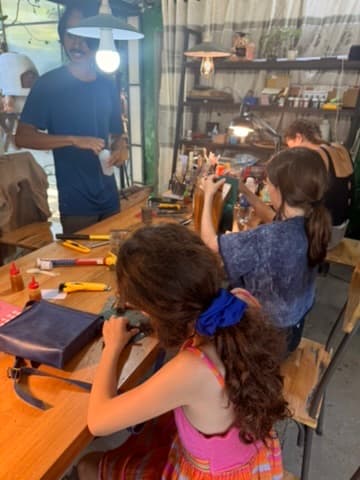
In a worldschooling family, the world is the classroom. A morning at a market becomes math and conversation. A workshop with a local maker becomes a craft and a friendship. A beach, a farm, a museum, a temple: each one a real place to learn something and contribute to it. Structured foundations still have their time. Both modes matter.
It comes in stages. Some families live it full-time. Some travel during school holidays. Some are simply curious and trying it for the first time. All three are worldschooling. You can start small and keep every option open.
The most common worry
You don't have to be the teacher.
Many parents hear "worldschooling" and picture themselves standing at a whiteboard, somehow teaching every subject on their own. That is not what it is. Worldschooling does not turn you into the schoolteacher.
The world does much of the teaching. So do real-world teachers, the hubs your family joins, the other families around you, and your child's own curiosity. Your job is closer to a guide who shapes good days and chooses good places. Plenty of worldschooling parents have never taught a class in their lives, and their children are doing beautifully.
Already travelling with your children?
You might already be doing this without a name for it. A lot of families are learning through the world, and have no idea there are whole communities and programs built around exactly that. If your children are learning from the places you go, you are closer than you think. The next step is simply finding your people and a bit of structure to lean on.
Common questions
The things parents ask when they are first looking into it.
Worldschooling is an approach to education that uses travel and the real world as the classroom. Instead of learning only from a textbook in one room, children learn through the places they visit: markets, workshops, farms, museums, nature, and the people who live and work there. It can run alongside structured reading, math, and language. Families do it full-time, part-time during school holidays, or as a first experiment. It is a way of learning, not a long vacation.
No. This is the most common worry, and it rests on a misunderstanding. Worldschooling does not mean you become the schoolteacher. The world does much of the teaching, alongside hubs, real-world teachers, the community of other families, and your children's own curiosity. Your role is closer to a guide who designs good days and chooses good places, not someone delivering lessons at a whiteboard. Plenty of worldschooling parents are not teachers, and their children thrive.
They overlap, but they are not the same. Homeschooling is about where and how the learning is structured, usually based from home. Worldschooling adds travel and the wider world as the main source of learning. Many families blend the two, and many homeschoolers move toward worldschooling once they realise the world can carry a lot of the teaching.
No. Worldschooling comes in stages. Some families are full-time on the road, some travel during school holidays, and some are trying it for the first time with a single trip or a single summer. You can start small and keep your options open. There is no single right way to do it.
Quite possibly, yes. Many families are already learning through the world without knowing there is a word for it, or that whole communities are built around it. If your children are learning from the places you go and the people you meet, you are closer to worldschooling than you might think. The next step is simply finding your people.
It is the question every thoughtful parent asks. Worldschooling families keep reading, math, and language going in whatever way fits their child, and many find the real-world context makes those foundations stick better. Children also gain things a classroom rarely offers: independence, adaptability, and a genuinely global view. What matters most is being intentional, and you do not have to figure that out alone.
Start by learning what it actually involves, then connect with families already doing it. Edventures runs a free Worldschooling 101 class (in the works), a membership community of worldschooling families, and pop-up hubs where children learn together and parents find their footing. You can begin with a single trip or a single summer, no big leap required.
Where to go next
Wherever you are in the journey, there is a gentle next step.
See how learning works
The day-to-day of an Edventures hub: balanced days, real-world teachers, structured foundations alongside hands-on projects.
Our approachFind your people
A community of worldschooling families swapping honest advice, comparing destinations, and figuring out the next move together.
The communityTry it in person
Pop-up hubs where children learn together and parents find their footing. A single summer is a real way to begin.
See the hubsTake it at your pace.
Get on our list for stories from the road, hub news, and a heads-up when the free Worldschooling 101 class is ready to watch. No pressure, no spam. Begin when the time is right.